Expedition Study Area 2: Desa Aek Nauli
The team assembled by the village headman at our second study area Desa Aek Nauli was even more jovial than the first group, and that is saying something! They appeared genuinely enthusiastic about bringing us up into their mountains, and even said so. We set out for the surrounding hills on a sunny day with Siamangs calling; always an auspicious sign. We were also delighted to hear that another wooden shelter awaited us should we need it. This area, which is on the opposite side of the mountain range to Desa Perba Tua, did not feature the extensive benzoin plantations in the lower elevations of the hills; instead, the moment we began climbing in elevation we found ourselves almost immediately in healthy forest, with a muddy wild pig wallow not far from the start of the trail.
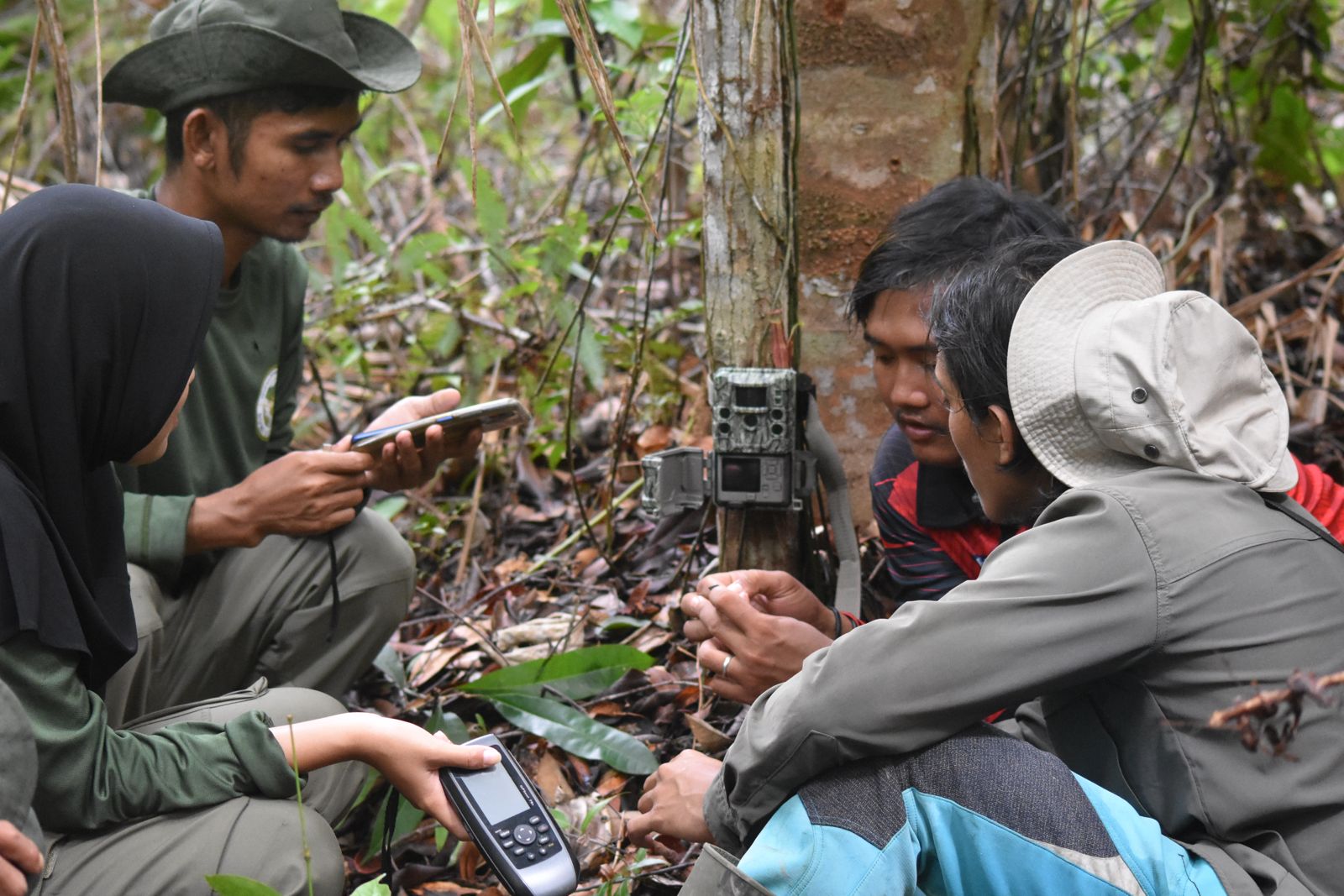
Nonetheless, rains from the previous day made the going slippery and tough, and it took approximately five hours to reach the wooden shelter near the summit at an elevation of over 1400m asl. Yet, on the way up, we identified two promising-looking camera stations and installed trail cameras there.
With a thick and seemingly boundless forest cover stretching in all directions, it was easy to envision Sunda Clouded Leopards, Marbled Cats, and Asiatic Golden Cats triggering these cameras…and quite possibly Sumatran Tiger. Perhaps most enticing of all, our guides said this region was inhabited by the Sumatran Striped Rabbit (Nesolagus netscheri). With this in mind, we positioned one of our cameras lower to the ground, for a chance of recording them; trail cameras placed lower to the ground also have a greater chance of capturing images of Critically Endangered Sunda Pangolins, which we were told also inhabit these mountains.

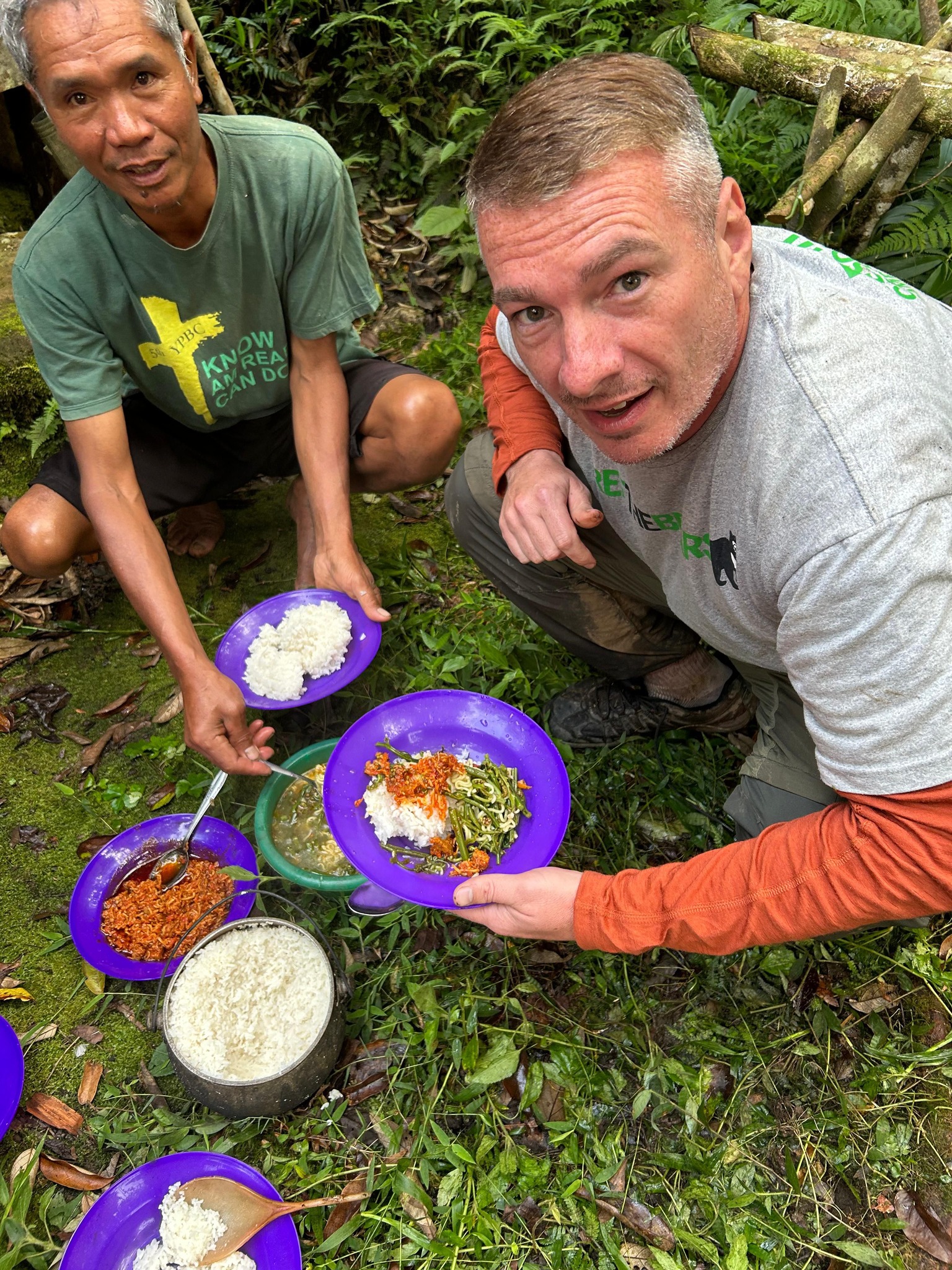
Surprisingly, our local guide team had never heard of the pispis ria grasslands that we had seen days before on our expedition out of Desa Perba Tua, indicating to us that usage of the forest was intensely localized. Rains arrived in the late afternoon, and dinner was cooked outdoors before the deluge. The following morning we trekked up to the ridgeline deploying two additional cameras where signs of Sun Bear, Sunda Pangolin, barking deer, and wild pig were evident. We decided to take a different route down the mountain to get a better feel for the forest. Rhinoceros hornbill, as well as many other birds were heard before the rain arrived, and we made it back to Desa Aek Neuli in high spirits.
We left Desa Aek Nauli, as we did in Desa Perba Tua, feeling as though we had established not only a good working relationship with the community but a genuine friendship with them. With both Desa Perba Tua and Desa Aek Nauli located in the extreme north of LNL, their connectivity to the northern section of HHDSL is very strong; with only small roads and villages and small rivers separating them in sections. Migrating tigers could would have little problem in moving between LNL and HHSDL up in these northern two study areas. Overall, the PRCF reconnaissance mission in the two first study areas got off to an amazing start.

Expedition Study Area 3: Desa Simpang Bolon
After a long but cordial discussion with two headmen from study areas three and four, Desas Simpang Bolon and Garoga Sibargot respectively, who jointly agreed to provide us with guides to take us into the forested mountains nearby. We were set to begin the next stage of the expedition in the central section of LNL.
A twenty-minute drive from the meeting house in Simpang Bolon brought us to the edge of a rubber plantation. From here we set out on a 45-minute walk until we reached the forest. This was a “hard edge” environment where thick forest comes to an abrupt halt at a plantation, in this case rubber. We trekked for an hour into the forest where the terrain became immediately hilly and steep (no doubt the reason why the plantations had been halted where they were). Our guide told us that a few years ago he had seen tiger pugmarks on the other side of the next valley, so we decided to install a camera over there.
En route, we came upon a large fallen tree that spanned a small gorge, forming a natural bridge (see Figure ten8 above). From previous experience in Sumatra and Cambodia, I knew that “tree bridges” such as these are gems for camera-trapping, so we stopped to install one at this location. With that done, we moved on towards the supposed tiger haunt, but not before installing another camera near signs where a sun bear had been digging. The day was clear, raptors could be heard calling in the sky, and despite some slips and falls on the steep hillsides, we were in good spirits.
Finally, we reached the former ‘tiger spot’ but couldnt find any recent signs of Mr. Harimau. Nonetheless, the forest was thick and healthy here and felt sufficiently far enough away from the plantations to install another camera. Curiously, despite the good weather, I never heard any gibbons calling. A hike of a day or two would bring us into increasingly rising foothills of a larger mountain at much higher elevation, and that may be exactly what we do on our next trip. One the way back we found one more enticing-looking camera station on a game trail, so we installed one more: images of forest cats flitted through my mind as if on an old film reel
Check back in next week when we share the final entry of Dr. McCann’s field journals.